
The Geography of Home
The Book ThiefThis flow traces how places shift from hostile settings into emotional landmarks and finally into ruins.
increasing Bearing strength in each event
 decreasing
Bearing strength in each eventdecreasingNameless Cemetery

Nameless Cemetery
Burial and Isolation
Werner is buried in an unnamed town while Liesel digs into frozen snow. The cemetery becomes the first place where grief and theft meet.
A Portable Memory
The stolen book carries the cemetery into every later home. Liesel’s sense of place begins with something she can hold.
Himmel Street
Himmel Street
False Heaven
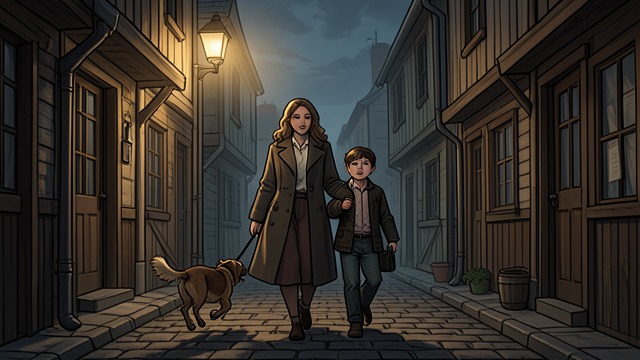
Himmel Street is neither paradise nor hell, but a poor neighborhood shaped by work, insults, hunger, and affection. Liesel gradually learns its rhythms.
Emotional Center
The street becomes home because Hans, Rosa, Rudy, and Max give it meaning. Its eventual destruction therefore becomes the destruction of Liesel’s world.
The Amper River

The Amper River
Lessons and Theft
Hans teaches Liesel beside the Amper River, and later Liesel and Rudy steal, swim, and play there. The river holds freedom beyond domestic and political boundaries.
Memory’s Current
Books, bodies, and promises repeatedly approach the river. Its movement contrasts with the fixed violence of streets and camps.
Grande Strasse

Grande Strasse
The Mayor’s Hill
8 Grande Strasse represents wealth, silence, and access to books. Liesel first approaches it as a worker and later as a thief.
A Reversed Threshold
The window becomes an invitation, then a site of anger, forgiveness, and writing. Grande Strasse shifts from class barrier to complicated refuge.
Rubble of Himmel

Rubble of Himmel
The Street Erased
The bombing of Himmel Street turns familiar houses into a mountain range of rubble. Liesel can no longer navigate by the landmarks that shaped her childhood.
Memory’s New Map
She locates home through bodies, the accordion, and words rather than buildings. The ruined street becomes the origin point of her lifelong testimony.
January 1939
January 1939 onward
1939 to 1943
1940 to 1943
October 7 1943
